What is BODMAS?
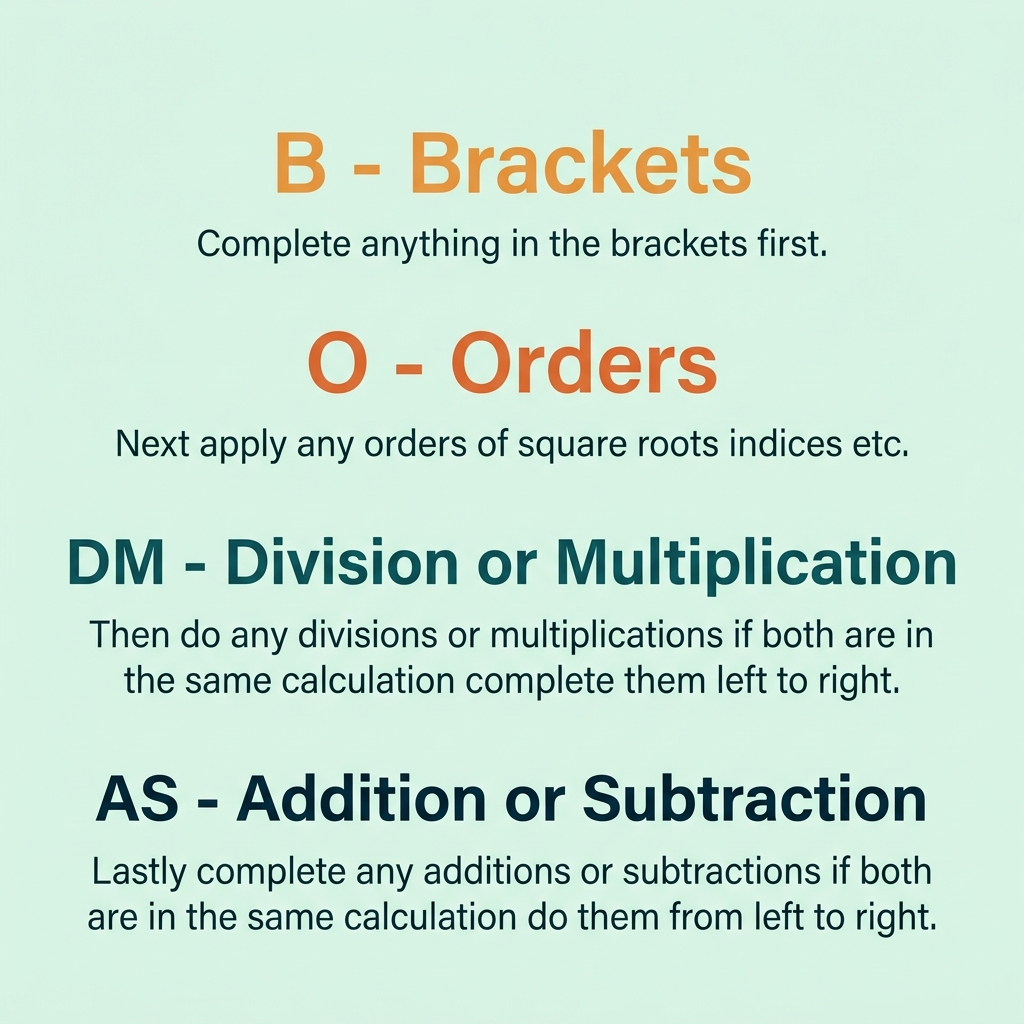
BODMAS is a mnemonic that represents the correct sequence of operations for solving mathematical expressions. BODMAS stands for Brackets, Orders, Division, Multiplication, Addition, and Subtraction. The BODMAS rule ensures every math expression produces one correct answer by defining which operation to perform first.
Without the BODMAS rule, the expression 3 + 4 x 2 could give 14 (wrong) or 11 (correct). The BODMAS calculator tool applies this sequence automatically to solve math expressions and provide a step-by-step solution.
What is BIDMAS?
BIDMAS stands for Brackets, Indices, Division, Multiplication, Addition, and Subtraction. BIDMAS is the same order of operations as BODMAS — the only difference is the word "Indices" replaces "Orders." Both Indices and Orders refer to powers and square roots (exponents).
BIDMAS is the preferred term in British schools and textbooks. Teachers in England, Wales, Scotland, and Northern Ireland use BIDMAS to teach students the correct sequence for solving mathematical expressions. The BIDMAS rule produces the same results as BODMAS for every calculation.
What is PEMDAS?
PEMDAS stands for Parentheses, Exponents, Multiplication, Division, Addition, and Subtraction. PEMDAS is the order of operations standard used in the United States and follows the same mathematical rules as BODMAS and BIDMAS.
The difference between PEMDAS and BODMAS is regional naming — not mathematical logic. "Parentheses" replaces "Brackets," and "Exponents" replaces "Orders." Both systems produce identical results for every arithmetic expression. A common PEMDAS mnemonic is "Please Excuse My Dear Aunt Sally."
BODMAS Meaning
The meaning of BODMAS is a fixed order of operations used in arithmetic and algebra. BODMAS tells which mathematical operation has higher priority over others. Brackets have the highest priority, followed by Orders (exponents and roots), then Division and Multiplication (left to right), and finally Addition and Subtraction (left to right).
BODMAS is used in India, the UK, and Australia. The same concept is called PEMDAS (Parentheses, Exponents, Multiplication, Division, Addition, Subtraction) in the US. Both BODMAS and PEMDAS follow identical mathematical rules -- the difference is regional naming.
BODMAS Full Form
The BODMAS full form breaks down into 6 operations arranged by priority:
BODMAS Mnemonic
The BODMAS mnemonic helps students and professionals remember the order of operations without memorizing formal rules. Each letter maps to one operation in the correct priority sequence: Brackets, Orders, Division, Multiplication, Addition, Subtraction.
3 common BODMAS mnemonic phrases include:
- Big Old Dirty Muddy Ankle Socks
- Bears Often Dance Merrily After Sunset
- Bring Our Dinner, Mom And Sis
How to Solve Math Expressions Using the BODMAS Rule
To solve a math expression using the BODMAS rule, follow these 4 steps in order:
- Solve all brackets present in the math expression -- start with the innermost bracket first.
- Solve the order or exponent terms (powers and square roots) of the expression.
- Perform division and multiplication operations from left to right.
- Perform addition and subtraction operations from left to right.
Solve the leftmost operation first when more than one operation of the same type appears in an expression. The BODMAS rule calculator automates this entire process and displays each step.
How to Use This BODMAS Calculator
This BODMAS calculator tool provides a step-by-step breakdown of math problems to show exactly how the final result is reached.
- Step 1: Enter the mathematical expression into the input box. Use +, -, *, /, ^ (power), and brackets ( ).
- Step 2: Click the "Calculate" button to process the expression using the BODMAS rule.
- Step 3: Review the detailed solution to see each stage of the calculation.
All calculations are processed using the standard mathematical hierarchy to ensure accurate calculations using the BODMAS rule.
What is the BODMAS Calculation Rule?
The BODMAS calculation rule is a standard mathematical order of operations used to solve multi-step equations. Without this rule, different people could calculate the same math problem and arrive at different results. The BODMAS rule ensures that every calculation is consistent and accurate.
BODMAS Acronym Breakdown
To understand the BODMAS rule, you must know what each letter represents in the hierarchy:
- B (Brackets): Solve the parts of an equation inside parentheses or brackets first.
- O (Orders): Numbers with powers (exponents) or roots, such as x^2 or sqrt(x).
- D/M (Division and Multiplication): These operations hold equal weight. Solve them as they appear from left to right.
- A/S (Addition and Subtraction): These are the final operations to perform. Solve these from left to right.
Why the Order of Operations Matters
Following the correct order is necessary for precision. Calculate a construction budget or a finance sheet incorrectly -- adding before multiplying leads to a significant error in the final total. Using a BODMAS calculator tool removes the risk of human error by automatically applying these rules to solve math expressions.
The BODMAS Formula and Order
The BODMAS formula functions as a mathematical map. It ensures you move through an equation in the correct sequence to reach the right answer. "Board mass formula" is a common misspelling of this standard mathematical hierarchy -- both refer to BODMAS.
Understanding the Hierarchy
In mathematics, not all operations are equal. Some must be completed before others to maintain the logic of the equation.
- Priority 1: Brackets -- ( ), { }, [ ]
- Priority 2: Orders -- exponents and roots
- Priority 3: Division and Multiplication -- left to right
- Priority 4: Addition and Subtraction -- left to right
The Left-to-Right Rule
Division does not always come before multiplication. In the BODMAS rule, Division/Multiplication and Addition/Subtraction are "paired" groups with equal priority. Solve them in the order they appear from left to right.
How to Solve BODMAS Problems Manually
Solving math problems by hand is straightforward once you follow a consistent set of 4 steps:
- Step 1: Look for brackets. Solve everything inside them first.
- Step 2: Solve the "Orders." Calculate any square roots or numbers with exponents.
- Step 3: Perform division and multiplication. Start from the left side of the equation and move to the right.
- Step 4: Perform addition and subtraction. Move from left to right until you reach the final total.
Using the BODMAS Solver
Use a BODMAS solver to avoid mistakes when you have a long equation. The BODMAS solver is the most efficient choice for complex arithmetic expressions.
- Step 1: Type the full mathematical expression into the input field.
- Step 2: Press the "Calculate" button to trigger the order of operations.
- Step 3: Review the result and the step-by-step breakdown provided.
This math expression solver shows you exactly where each number comes from, providing instant results with a user-friendly interface.
Practical BODMAS Example
Follow this practical math problem to understand how a BODMAS solver works:
Expression becomes: 12 * 3 + 2 - 4^2 + 18 / 3
Expression becomes: 12 * 3 + 2 - 16 + 18 / 3
12 * 3 = 36, then 18 / 3 = 6
Expression becomes: 36 + 2 - 16 + 6
36 + 2 = 38, then 38 - 16 = 22, then 22 + 6 = 28
Common Mistakes to Avoid
Recognizing these 4 common errors helps avoid mistakes when solving BODMAS problems manually:
- Left-to-Right Errors: Forgetting that multiplication and division have equal priority. Solve them in the order they appear from left to right.
- Bracket Confusion: Attempting to solve numbers outside a bracket before finishing the operations inside.
- Misunderstanding Orders: Treating exponents as simple multiplication or ignoring exponents entirely.
- Addition Before Division: Starting at the beginning of an equation rather than following the BODMAS rule hierarchy.
When to Use the BODMAS Rule
The BODMAS rule is a fundamental part of algebra and daily logic. It applies in 4 practical scenarios:
- Academic Work: Completing algebra homework or preparing for standardized math tests.
- Scientific Research: Ensuring complex data formulas are calculated with precision.
- Programming: Checking the logic of computer code to prevent calculation errors.
- Financial Planning: Managing budgets or interest rates where the order of operations changes the final amount.
Using a BODMAS calculator ensures these tasks are handled accurately without the risk of manual mistakes.
Examples of BODMAS Problems and Their Solutions
Here are 5 examples of BODMAS problems:
Key Features of Our BODMAS Calculator
This BODMAS calculator tool includes 6 key features:
- Accurate Calculations Using BODMAS Rule -- Every expression follows the correct order of operations.
- Step-by-Step Solutions -- See each stage of the BODMAS calculation steps displayed clearly.
- Supports Complex Expressions -- Handles nested brackets, exponents, and mixed operations.
- User-Friendly Interface -- Clean input field with instant results provided.
- Keyboard Available for Inputs -- Type expressions directly or use the on-screen keyboard.
- Instant Results -- Get answers in a fraction of a second.
This BODMAS calculator tool handles complex arithmetic expressions without manual errors, making problem-solving faster and more efficient.
Input Instructions
To use the BODMAS calculator:
- Type the math expression in the input field.
- Use +, -, *, / for basic operations.
- Use ^ for exponents (e.g., 4^2 for 4 squared).
- Use ( ), { }, [ ] for brackets.
- Click the "Calculate" button to get the result.
Algebra Instructions
To solve algebraic expressions with this BODMAS calculator:
- Select the type of algebraic problem.
- Type the algebraic expression. Use x^(2) for x squared, separate multiple expressions by commas.
- Click "Solve" to get the step-by-step solution.
Statistics Instructions
To solve statistics problems:
- Select the statistics question type.
- Type the numbers (data) separated by commas.
- Click "Solve" to calculate the result.
Matrix Instructions
To solve matrix problems:
- Select the matrix question type.
- Type the matrix elements enclosed in small brackets, separating elements by spaces and rows by commas.
- Click "Solve" to get the solution.
Note: Separate each element by a space and each row by a comma.